Home to rich 20th-century French architecture and even richer agricultural land, Battambang took us by surprise with all it has to offer.
Upon arriving in Battambang by bus, we were greeted by the typical taxi operators waiting to get a job from the tourists disembarking from their bus. As I took a step away from the terminal, I was greeted by a man named Kim, who was offering to take us to our hotel and insisted we take him up on one of his tours, which he personally operates. We agreed, and I was to text him with a date for when we would like to go with him. Nothing prepared us for the plethora of sights we were about to see (and unable to unsee in some circumstances).
So the day arrived, and at 10 am we were picked up by Kim and first taken to a local market and shown what kind of produce was available. He specified that this first market he took us too was for the lower income families and would later take us too the higher income market. It’s an understatement to say we were stunned by the sights of the market and the products on sale, our highly aesthetic and backpacker journey suddenly took a turn, but one that felt very real and authentic. Personally, I think I was the only one in our party that enjoyed this section of the tour. The market was filled with carcasses of all types of animals (even some that many in the world consider pets), vegetables I have never laid my eyes on before and insects fried, seasoned and ready for sale by the scoop.

The rest of the morning consisted of a historical city tour, with tales of French rule and stories of Japanese occupation. Taken to the more upscale market, we were shown how the French influence has shaped the centre of Battambang having built French buildings along the river as well as the central market. Monuments and sculptures lined the streets of central Battambang representing a very diverse cultural background, with hints of influence from the French, Japanese and the ancient Khmer culture. We briefly stopped at a central roundabout to learn about the island sculpture, Mr Battambang who goes back centuries in mythical Khmer folklore and how its importance gave this historical city its name.

As well as the historical monuments throughout Battambang, there is also monuments symbolising Cambodia’s more recent and dark history. One of which, is the Naga for Peace and Development monument – naga being a mythical multi-headed serpent -, constructed using destroyed and decommissioned weapons that were once used by civilians in the Battambang province during the Khmer Rouge regime. We were told the monument stands as a symbol for peace for the Cambodian people and to mark the end of the brutal history Cambodia suffered during the Cambodian civil war and the Cambodian-Vietnamese wars. At the time of visiting, birds could be seen setting up nests in and around the crevices of the monument, something that only strengthens the message, I think.

Heading out of the urban centre of Battambang, Kim started to guide us around some of the countryside, teaching us everything there is to know like the different fruits growing on the trees, the plants that can be found and when it is all in season. At one point Kim pulled over abruptly in his remork to show us a flower from a silk cotton tree (I believe). Not knowing what to do with the plant he has just handed to me, the cotton fibres of the plant starting flying off into my friends faces as he sped off to the next notable stop. Funny as it was for me, it wasn’t for everyone. Other notable stops include to try a wild fruit known as stinking passion flower which consisted of a thin skin filled with slime like covered seeds, which were actually very sweet and enjoyable.

Battambang is famed among backpackers for its bamboo train which you can ride for $5 USD, it consists of a bamboo cart (sits 4 people) on rail wheels attached to an small motorbike engine. We arrived just after lunch to the station (which coincidently looked more like a British industrial estate in the middle of nowhere), where Kim ushered us off to take a half an hour ride on the train while he enjoyed some light lunch he picked up 10mins before from a roadside vendor.

The cart laid with leather cushions, I was dreading to sit on one having been sat in the 28 degree C sun for god knows how long. Flipping them over made them slightly more bearable and off we went, making both road and bridge crossings along the way. We arrived at a stop and the driver asked us to turn around and head back passing the start point and heading the other way now. We stopped at the end and were told we would be waiting 10mins at this rest stop, which also happened to be a shop just off the track (could’ve seen this coming). After having an ice cold Fanta break, we finally headed back and were encouraged to give a tip (which we did, I think around $5). Very interesting excursion but not worth going out of your way. We were then told how these bamboo carts were put in during the Khmer Rouge era due to heavy bombings of the Cambodian rail.

Afternoon stops in the Battambang countryside included a local fruit sellers shop, a walking rope suspension bridge across a river and a solemn cemetery to remember the fallen during the Khmer Rouge era, where a large tree full of fruit bats endures, almost watching over the fallen. Built on the grounds of a Buddhist temple, this unique area is kept well away from the city and is well maintained by the locals. You can find it here.

To finish the day we visited the killing cave and bat cave located around 10km from Battambang centre and atop a steep mountain, Kim dropped us off near a large Buddha that sits cliffside and contacted his friend to pick us up to take us up the steep path to the cave and temple at the top (under the assumption the remork wouldn’t be able to make it up). We bungled into the bed of the drivers pickup and proceeded to head up towards the cave – we were told we could walk for free but after summiting, we decided we made the right choice as we passed foreigners wiping the sweat from their brows from the Cambodian heat. The first stop was the Killing Caves of Phnom Sampeau, where statues laid the entrance of the cave displaying ways in which people were executed or tortured before being laid in the cave. This cave was estimated to have been where 10,000+ innocent people were killed and dumped, it was a steep walk down into the cave but it was not a large cave by any means.

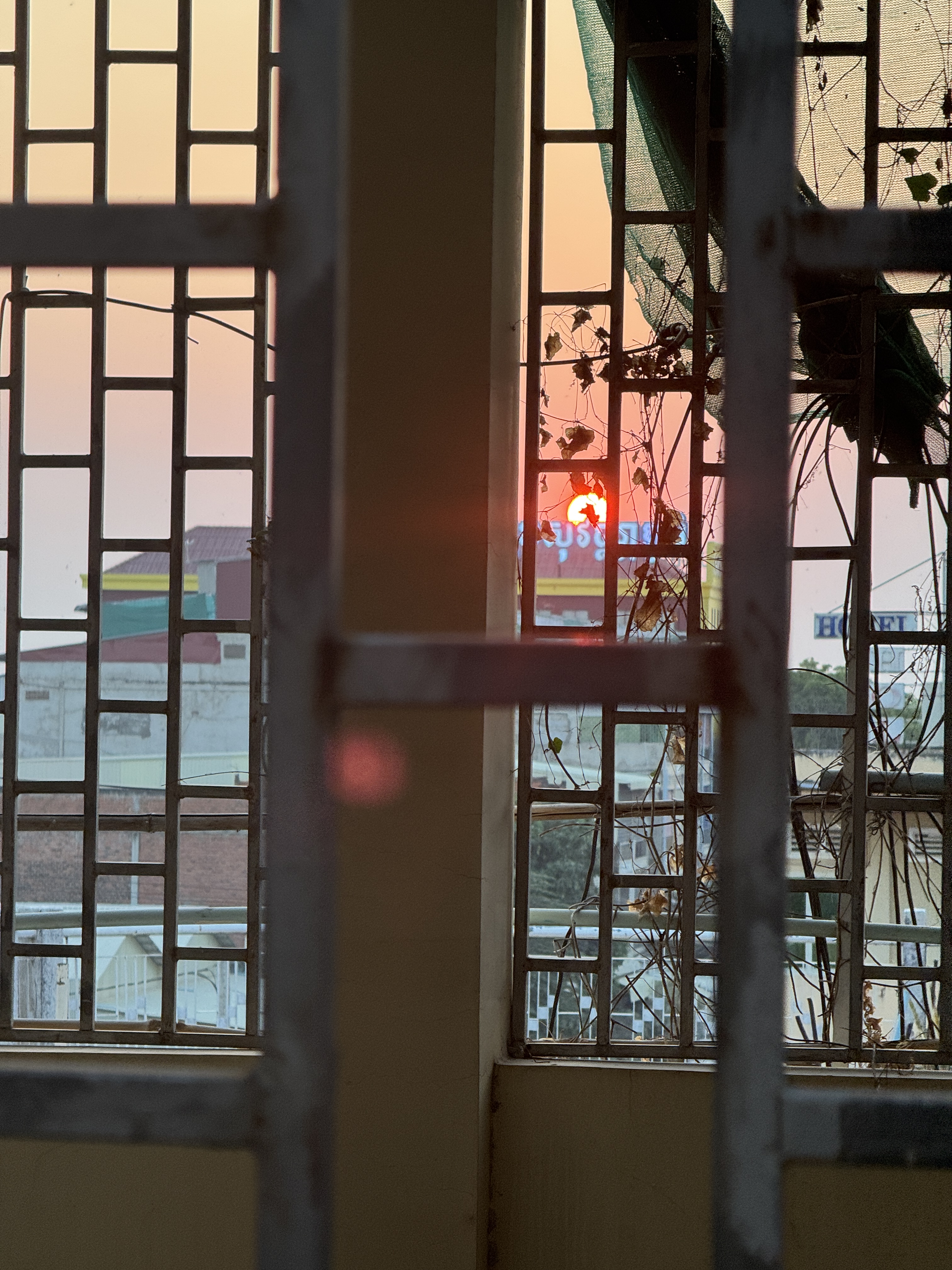
We left the cave – feeling very somber as we left – and headed back to the pick up to visit the temple on the other side of the mountain. As the sun started to set, the top of the mountain offered beautiful views of the vast and flat landscape of Battambang, where all to be seen for miles is countryside homes and thriving agriculture. The main temple, Phnom Sampow is adorned in gold ornaments and features blue and pink tiles lining the steps up to the entrance and the adjoining gold pagoda sparkles from the reflection off the setting sun.


We eagerly headed back to our driver to make it to the bottom for 6pm for the grand finale (we arrived back at the pickup truck to see him drinking a beer, but I guess only one while working is fine, right?). Back at the bottom, café workers ushered us to sit down and get a drink while we wait. We sat in silence, waiting for what seemed to be a normal cave to erupt with activity. Right on cue, people started pulling out their phones to record as a whirlwind of millions of bats burst out of the cave to fly off into the sun setting horizon. This is a daily occurrence for the bats and for the locals that run shops around the mountain, but for us it was one of the craziest experiences we have ever seen. Millions of bats flew out of a cave opening in the cliff, what seemed never ending took around 20mins for all of the bats to leave. It was both bewitching and stunning.

Throughout everywhere I’ve been in Cambodia, Battambang has to be one of my favourite places I’ve seen. Although the people have suffered such a dark past, the warm smiles from the local shop owners and the waves from the delightful children as you drive past make it such a welcoming place to be and I love it for that. Kim asked for just $25 for the day tour while providing us with activities, drinking water throughout the day, paid fruit and incredible insights and history lessons, we tipped him for what we felt appropriate and thank him for introducing us to another side of Battambang. If you happen to be in Siem Reap on your travels, I definitely recommend stopping here for a couple days.


Leave a Reply